When I start working with clients, they almost NEVER have the issue of not having anything to communicate about. They, like you, are so passionate about their business and can talk about it at length on whatever platform they have available.
So, what’s the issue?
The problem most of my clients are facing is there is TOO MUCH they want to communicate about, and they don’t have the bandwidth to talk about it all. They’re wearing many different hats at their jobs, and communications is just one small piece of the giant puzzle they put together each day to make their organization or business a success. When they start working with Kelly Communications, I help them develop a communications plan and calendar to get the right content out to the right audiences on the right platform at the right time. One of the first things we do together is prioritize the stories they want to tell, and here’s how we do it.
Have you ever heard the phrase kill your darlings? In the creative writing world, it’s when a writer deletes a character, a plot point, or some other detail in order to help the story get better. And, as an author, this can be tough because that character, that plot point and those details are a piece of you. The same goes for a communications strategy. We have to make the plan the best it can be, and that may mean killing your darlings.
So how do we decide what makes it and when, and what gets left on the cutting room floor? This handy dandy decision matrix, available for download for free right here.
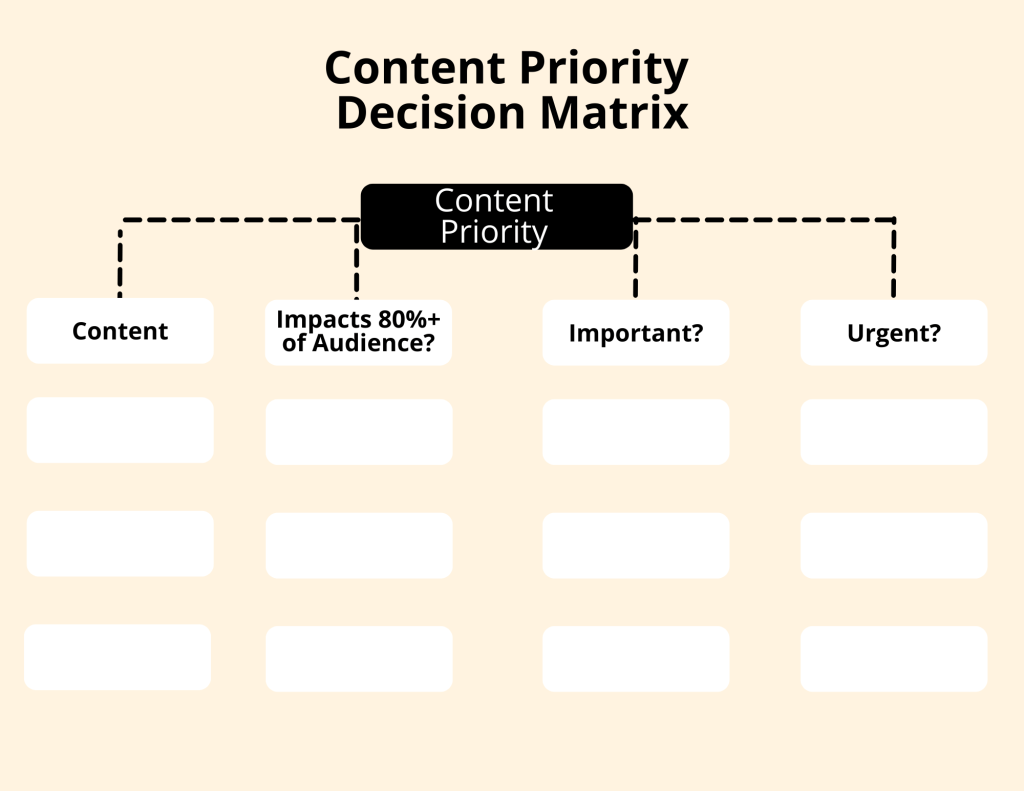
This decision matrix helps you make objective decisions about your content so your personal preferences don’t get in the way of making the right choice. You start by writing your content pieces or ideas in the left column. The template has three spaces, but you can make the matrix as long as you need. Then, moving to the right, you answer each question on a five-point scale: –, -, 0, +, ++. The double – means absolutely not, and the ++ means absolutely yes, with everything else falling along the spectrum in the middle. When you’re done rating each content piece against each criterion, add up your plus signs and delete your minuses, and whichever content piece has the most + beside it is your top priority.
Check out the video below as I go step-by-step through a decision matrix, then try it for yourself. And, be sure to comment below with what templates and how-to guides you’d like to see next.
 Kelly Communications
Leave a comment